

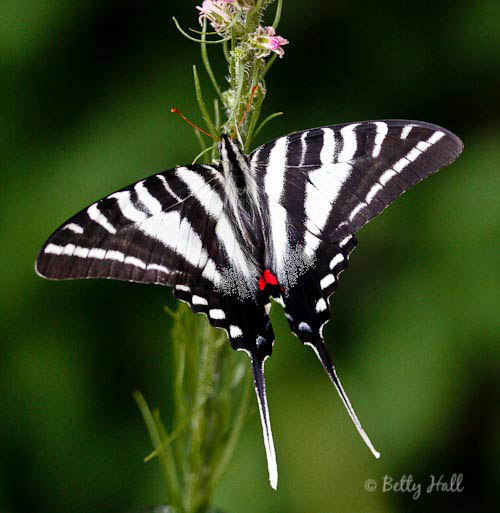
The Zebra swallowtail is one of my favorite butterflies. I’ve often seen this butterfly while hiking woodland streams and watching for spring wildflowers. And I have seen it in our Lexington, Kentucky, backyard twice in the last two years. This photograph is special to me, because the butterfly is one I raised, and it was made shortly after the butterfly emerged from its chrysalis.
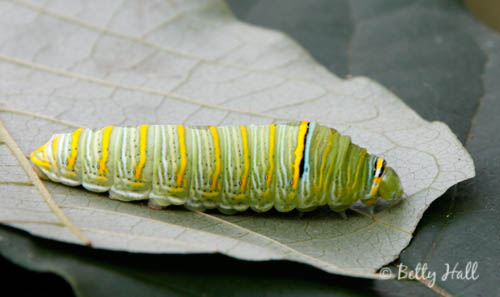
This is the zebra swallowtail caterpillar, which my friend, Connie brought to me. At this stage it is about one-half inch long and feeding on paw-paw leaves, the only leaves it will eat.
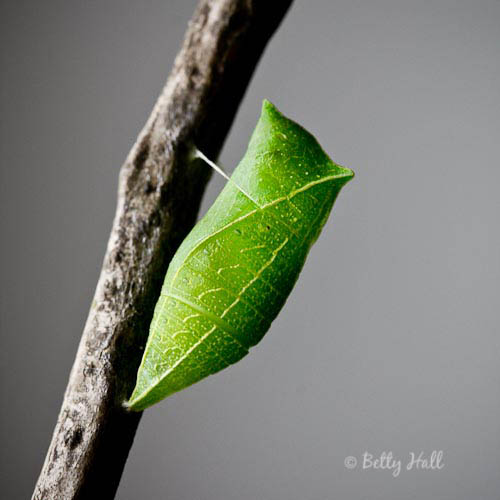
One week later it was about one inch long, and it then made this chrysalis.

Two weeks later it emerged from its chrysalis at the left of this image and became a mature buttefly. After a couple of hours, it’s wings were hardened, it took flight and was gone. I’m ever amazed at the wonders of nature, which certainly include the life cycles of butterflies and I thoroughly enjoyed observing this one.
Gorgeous images. I am LOVING the blog. Keep it up!
Wonderful! Thank you for sharing. Zebra swallowtail larva only eat pawpaw leaves like monarchs only eat milkweed. I wonder, is each variety butterfly as dietarily selective?
Beth, good question. As to butterflies being selective – it depends. Pipevine swallowtail lays eggs only on pipevine. Spicebush only on spicebush and sassafras. Black swallowtail on members of the carrot family, dill, fennel, parsley, carrots, and Queen Anne’s lace. Not all are as restrictive – but most need native plants.
Zebra swallowtail will also eat the leaves of soursop. Soursop is in the same family as paw paw.
Thanks for your comment, Leona. I did not know about Soursop. It looks and sounds like an interesting evergreen tree and fruit. I see it grows in the U.S. in Florida and further south into Central America but can not tolerate our colder temperatures. Thanks for sharing. Betty
There are toxins in the leaves and it protects them from predators. When the adult emerges, it is said to still have some remaining toxins, that continue to protect them.
Beautiful Betty. I love the detail you captured in that first image.
My 1st grader was chosen to do a class project on Zebra Swallowtail Butterflies and I found your page very helpful and educating. We are both excited about to learn that you had them in your own backyard. We will soon be moving to Kentucky and hopeful we can take care of some as well! Thank you so much for posting such beautiful pictures. =)
Good job, Betty. I’m raising larvae now. Any hints on keeping pawpaw cuttings from wilting? (parsley is easy…) Will these late August zebra pupae hatch or overwinter – (near Baltimore)? If the latter, how to care for them? I have overwintered tiger swallowtail pupae.
Thanks, Sue. I’m impressed that you have zebra swallowtail larvae right now. As to keeping pawpaw cuttings fresh – all I know to do with shrubs is keep the cuttings shorts, cut the stems on a slant, and change the water frequently. And sometimes I make vertical cuts at the bottom of the stem.
I would guess the chrysalises will not emerge until spring but can’t be sure. As to overwintering, I’ve kept chrysalises in our garage but I also think they will do fine in a sheltered spot outdoors. I would guess whatever worked for the tiger swallowtail will also work for the zebra.
I’ve never found a tiger caterpillar so you are ahead of me on that one.
Re: black swallowtail caterpillars. Ha, ha. First you plant dill, fennel and parsley with the intention of having fresh herbs. If you do cut a tiny sprig, you examine it with a magnifying glass for eggs or the freshly hatched caterpillars (they look like bird droppings at first). The neighbors think you are selfish for not sharing your herb garden in exchange for their tomatoes. Then you go to the grocery store and buy parsley and dill.
Yes, Sue, and next year you plant a lot more dill, fennel, and parsley. And then you look for other folks who would like to help you raise those caterpillars. Great fun!
You are right, Betty. They were all the black phase; I thought those were just a variety of the tigers. What do the tiger (yellow with black) caterpillars eat? Now you’ve pushed my challenge button. Lots to learn. Keep writing.
Sue, I understand that the tiger swallowtail often feeds on tulip poplars and sweet bay magnolias. Yes, no end to the learning.
Three of 5 zebras hatched. The other two aren’t doing anything, so maybe they’ve decided to overwinter. One of the black swallowtail pupae is past its hatching date. Thanks for the tiger info. We have lots of tulip poplars and lots of tiger butterflies. Next spring I will go caterpillar hunting. Also, by the way, the neighbors’ kids brought me an Io moth caterpillar. About 4 inches long. Wow. We didn’t cover the pail…and it seems to have escaped. hmmm I wonder how that happened???
Sue, sounds like lots going on there. The Io moth would be a most exciting find. Sorry it escaped.
Betty, this is fabulous!!!
I’d first seen Zebra Swallowtail here in Harlan County. Never saw in Ohio nor Boone County. I’d seen adults visiting Paw Paw trees and assumed they were laying eggs – perhaps I might spot a caterpillar on tree – no luck – had taken some cuttings from tree and had them in container with water on front porch to root.
Imagine my surprise and pleasure when I noted a diminutive caterpillar eating a leaf on one of my cuttings! It increased its size rapidly over succeeding days until it quit eating yesterday. Today I have a chrysalis!
Great story! Thanks for sharing. Hope you have a beautiful zebra soon.
I live near Dayton, Ohio and I saw my first Zebra Swallowtail visiting a butterfly bush in my yard this afternoon. It looked kind of beat up and only had one tail left. We live in the suburbs and don’t have any paw-paws so I don’t know why it was here but I’m sure glad it came for a few minutes and that I could see it!
Jackie, glad you got to see the Zebra Swallowtail. We, too, are in the suburbs and the closest paw-paws that I know about are two miles away. So we don’t see them often but it’s always special when we do. Thanks for sharing.
Saw a zebra on my butterfly bush here in Maryland. I’d never seen this type so had to photograph and search. I don’t know of any pawpaw trees in Maryland.
Teri, I checked Google and it seems that pawpaws do grow in Maryland. I’m delighted that you saw and identified the zebra butterfly. It is one of my favorites. I hope you may be able to see it again.
Betty
Most pleased to be back on Burk Mountain in Harlan County! Have Paw Paw trees – will eagerly await Zebra Swallowtails – have not yet learned where or how they spend the winter – bet I learn soon! DHB
Donald, you certainly did learn and obviously did good research. The message from your later e-mail is “right on”.
“Some of these Zebra chrysalises “overwinter” w own “antifreeze” I will look – doubt will find. Best bet may be on small PawPaw trees,our source of first adults here. Unlike Monarchs, which also has antifreeze, Zebras do not migrate.
DHBurk, any learnings where or how Zebra Swallowtails spend their winter?
I am going to try to catch a zebra catarpilar in my yard in the summer
Jillian, The Zebra Swallowtail butterflies are one of my favorites. The caterpillars are not easy to find but I wish you luck in finding one and seeing the butterfly emerge.
Thank you for including my comments!
Blessings and stay well!
Do keep up your excellent informative and gifted works!
DHB et al
Donald, I always appreciate comments. They are one of my favorite things about blogging.
hi , im a salem middle school student and im trying to find out how are these organisms helpful and harmfil to us ?
Dennis, Neither the Zebra Swallowtail butterfly or its caterpillar are harmful. Birds likely use some of the butterflies and caterpillars for food. The butterfly is beautiful to see and probably pollinates some flowers. Good luck with your school project.
How long do they live? I have similar ones that are yellow and black zebra striped, but they do not have red but blue where the red is, I wonder if this is a variation. I live in a suburb of Pittsburgh, Pa and we have several butterfly bushes, which bring them every year and it is lovely to watch. They are very adapt at getting the pollen out of the flower tubes. I have collected some great pictures and each year I the winter I print them out and hang them around the house to remind us that summer is eventually coming.
Laura, I’ve never seen a zebra swallowtail that was not black and white. Are you familiar with the Tiger Swallowtail that is yellow with black stripes? Most butterflies live about two weeks. I, too, enjoy butterfly images as a welcome reminder of summer during cold winter days.
Any update on chrysalis sighting in Harlan County?
Not yet, however I know there have been sightings of adult zebras in Kentucky. And if there are adults, surely chrysalises will appear with time.
I just noticed your blog. It’s great! I would love to start raising zebra swallowtails in San Antonio. I used to raise so many other species, but had to stop. I bought some paw-paw trees, in hopes that this could be a start, but the trees were so small, and only one survived. I hope to one day begin collecting again, and your blog sure inspired me!
Tim, glad to hear from you. A word of warning – raising butterflies can be addictive:-) It has been quite rewarding for me.
Betty, I just saw this beautiful butterfly in my front yard. I didn’t want to interrupt the moment by running in the house for my cell phone to get a picture. I googled “black and white stripe butterfly in Kentucky” and was so pleased to find this page with beautiful photos and very helpful information. I just wanted you to know that more than seven years after your original post, it remains useful, beautiful and appreciated! Thanks so much.
Thanks, Judy. Your comment encourages me to keep blogging.
I have lots of pawpaw trees here in PA but no zebras to watch. Have hoped they’d make it in from the wilds but no luck in ten years. Do you know of a source for eggs, caterpillars or chrysalis that will ship to PA? Maybe then they’d hang around year round.
https://idlewildbutterflyfarm.com/about-us/
Joe, the above source might be a possibility. Might be worth checking out. I’ll continue to think about this and see if I can up with any other ideas for you. Good luck.
Betty
Hi Betty! Karen Mason here, Janet’s friend from TN. I am babysitting some Zebra Swallowtails for a friend. One made it chrysalis on a leaf on the floor of the container. Do I need to hang it up?
Congrats, Karen,on your babysitting job. I could easily be envious. As to the chrysalis, It will ‘probably’ work if you do nothing. However, if it were me, I would likely feel better to get it up off the floor. My favorite way is a dab of glue from glue gun on a twig and then place the chrysalis on glue (back side in glue).
Hope this helps.
Good luck.
How did you manage to keep the leaves from drying out? I have to replace the leaves daily, even in a flower tube of water. They seem to dry out so fast. Any ideas how to keep them fresh longer than a day?
It’s been a while since I raised them and I don’t remember a problem with the leaves. You might try gathering the leaves in the early morning (plants often have maximum moisture then). Also get the smallest leaves you can find? You might also wash the leaves when you bring them. (I often do that to be sure there are no insects on them). And maybe a larger container for water? I’ve not raised any Zebra lately but I have a friend and also our daughter who is raising them. I’ll ask them for any other ideas. Good luck!
Betty
Betty, so pleased to find your post. I am a friend of your daughters. This spring I noticed lots of zebra swallowtails in the spring before the paw paw trees even had leaves so I assumed they had over wintered. I found them on one of the islands on the Seven Island birding Park near Knoxville, TN.